
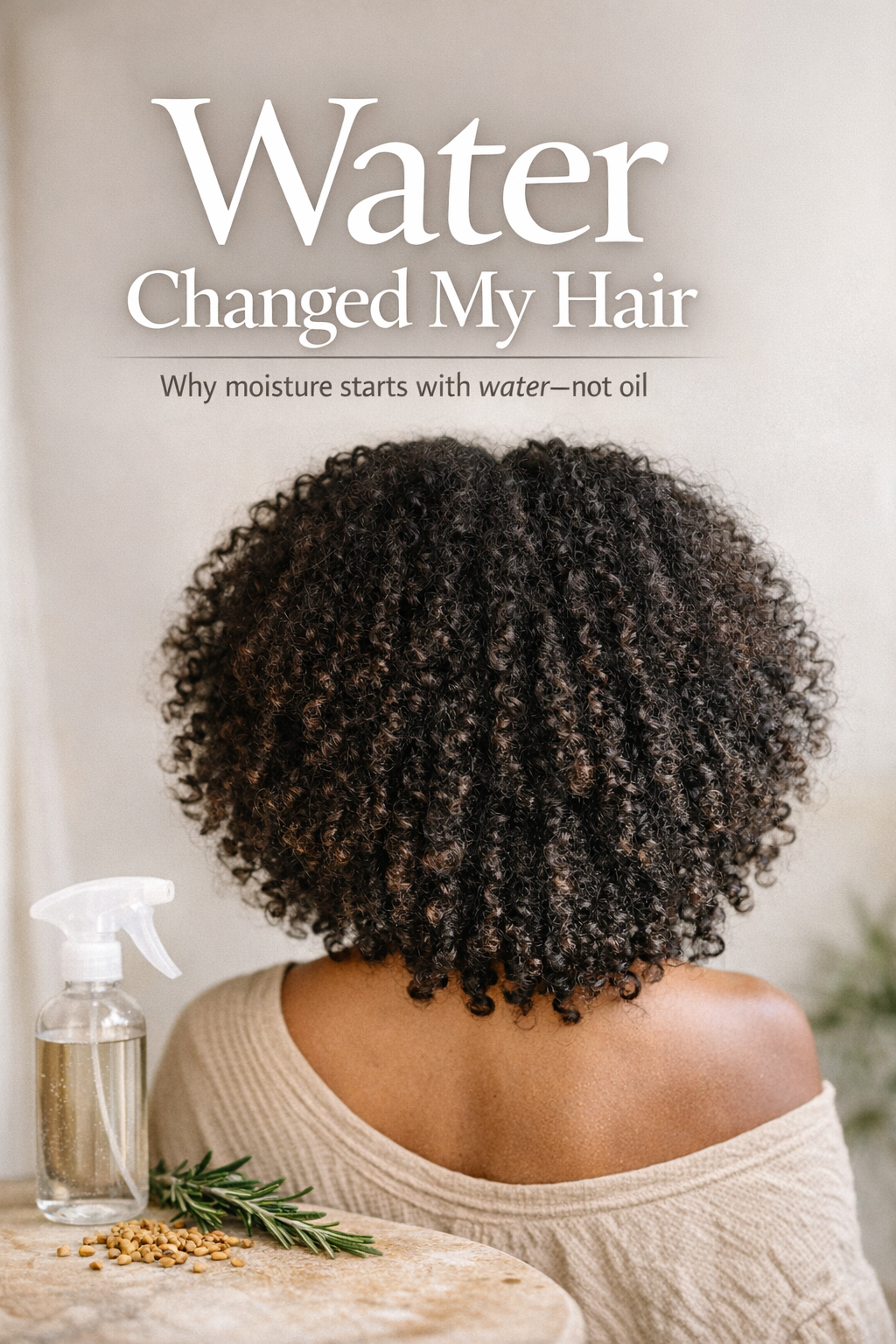
Growing up, we were always taught one thing about our hair: keep it away from water.
Don’t get your hair wet.
Don’t let water touch it.
Water was treated like the enemy.
So naturally, I grew up believing that oil was the answer to everything. If your hair is dry, add oil. If it felt rough, add oil. If it wasn’t doing what you wanted it to do, add more oil. That was the teaching, and I followed it for years without ever questioning it.
But part of learning how to truly work with my hair meant unlearning what I was taught, and running toward the very thing I had been taught to run away from.
Water.
What I finally came to understand is that water is moisture. Oil is not moisture; it only seals moisture in. According to hair science, water is the primary hydrator of the hair fiber, while oils function as sealants to slow moisture loss rather than hydrate on their own
https://www.ncbi.nlm.nih.gov/pmc/articles/PMC4387693/
Once that clicked, everything changed.
I began experimenting with water-based hydration. I started creating things that my hair actually responded to, rosemary water, aloe vera juice, and fenugreek seed water. Aloe vera, for example, is known for its high water content and humectant properties that help attract and retain moisture in the hair
https://www.healthline.com/health/beauty-skin-care/aloe-vera-for-hair
I would soak fenugreek seeds, strain the water, and spray it directly onto my hair before sealing it with oil. Fenugreek has traditionally been used to support hair strength and softness due to its mucilage content, which helps improve slip and hydration
https://www.ncbi.nlm.nih.gov/pmc/articles/PMC5452224/
For the first time, my hair felt hydrated, not just coated.
What I learned about my hair specifically is this: I could not put oil on dry hair and expect results. All it did was clog my pores and sit on top of my strands without actually moisturizing them. My hair needed water first—always—then oil. This aligns with what many hair scientists and trichologists explain: oils alone do not moisturize hair but help seal in existing moisture
https://www.scientificamerican.com/article/the-science-of-black-hair-a-story-of-pseudoscience-and-racism/
Water first.
Oil second.
That combination changed everything.
Today, my hair is manageable. It’s soft. It’s bouncy. It’s full of life. And when I look at where I started compared to where I am now, it honestly amazes me. The difference isn’t magic, it’s understanding. Understanding what my hair actually needs instead of doing what I was told it needed.
I’m grateful for this journey. Grateful for the trial and error. Grateful for the moments of frustration that pushed me to learn. And most of all, I’m grateful for the realization that water is the key. But for my hair, water alone isn’t enough; I have to lock that moisture in with oil. When I do both, my hair thrives. When I don’t, it doesn’t.
And that lesson didn’t just change my hair, it changed how I listen to myself, my body, and my needs.
This journey taught me that sometimes growth begins when we stop avoiding what we were taught to fear—and start learning what actually works for us.
References
Robbins, C. R. (2012). Chemical and Physical Behavior of Human Hair. National Center for Biotechnology Information
https://www.ncbi.nlm.nih.gov/pmc/articles/PMC4387693/
Healthline. Aloe Vera for Hair: Benefits and How to Use It
https://www.healthline.com/health/beauty-skin-care/aloe-vera-for-hair
Srinivasan, K. (2006). Fenugreek (Trigonella foenum-graecum): A Review of Health Benefits. National Center for Biotechnology Information
https://www.ncbi.nlm.nih.gov/pmc/articles/PMC5452224/
Scientific American. The Science of Black Hair: A Story of Pseudoscience and Racism
https://www.scientificamerican.com/article/the-science-of-black-hair-a-story-of-pseudoscience-and-racism/