
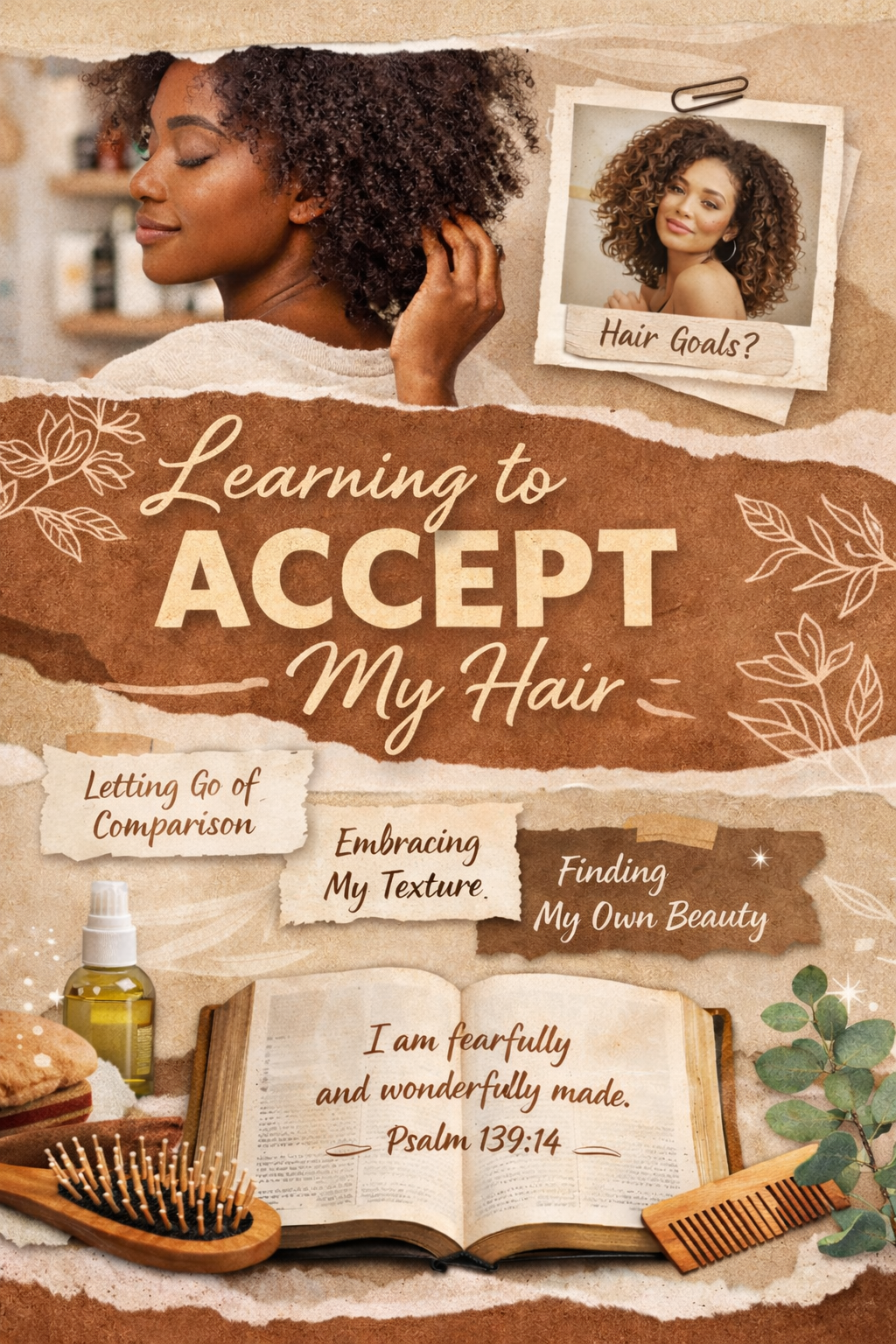
When I first became a naturalist, I thought the hardest part would be cutting off the perm and learning new products. I didn’t realize the real work would be learning how to accept my hair.
When I entered the natural hair space, I was excited, but also overwhelmed. Everywhere I looked, I saw women with big, fluffy curls, thick hair, and curl patterns that seemed so full and effortless. Online, it felt like everyone’s hair looked the same kind of “perfect,” and without even realizing it, I started comparing my hair to theirs.
I wanted my hair to look like that.
I tried everything. I followed routines that worked for other people. I bought products they swore by. I styled my hair the way they did, hoping that if I just did the same steps, my hair would eventually fall in line and look like everyone else’s. But it didn’t.
My hair wasn’t as thick. My curls weren’t as big. And no matter how hard I tried, my hair still didn’t look like what I was seeing online.
That’s when frustration started to set in.
What I didn’t understand at the time was that I wasn’t failing, I was just different. I hadn’t yet learned that natural hair is not one-size-fits-all. Research confirms that hair texture, density, curl pattern, and porosity vary widely from person to person, which means no single routine will work for everyone (Robbins, 2012).
As I spent more time learning, I discovered that I had low-porosity hair. That one piece of information changed everything. It explained why certain products just sat on my hair instead of absorbing. It explained why routines that worked wonders for others did absolutely nothing for me. Low-porosity hair has a tightly bound cuticle layer, making it more resistant to moisture penetration and requiring different techniques and product choices (NaturallyCurly, n.d.).
But even with that knowledge, there was still another lesson I had to learn, one that had nothing to do with products or techniques.
I had to learn to accept my hair as it is.
I had to let go of the idea that my hair needed to look like someone else’s to be considered beautiful. I had to stop chasing other people’s curl patterns and start paying attention to my own. That wasn’t easy, especially after years of being conditioned, subtly and not so subtly, to believe that certain textures were more desirable than others. Studies on appearance comparison show that constant comparison, especially through social media- can negatively impact self-esteem and self-acceptance (Fardouly & Vartanian, 2016).
Eventually, I realized something deeper: my hair wasn’t a mistake. It wasn’t lacking. It wasn’t something that needed to be “fixed.”
This is how God created my hair.
And once I really sat with that truth, my mindset began to shift. Instead of asking, “Why doesn’t my hair look like hers?” I started asking, “What styles actually complement my hair?” Instead of forcing my hair to behave a certain way, I began working with it.
I learned to embrace my texture. I learned what my hair likes and what it doesn’t. I stopped trying to make my hair fit into someone else’s definition of beautiful and started defining beauty for myself.
That’s when things began to change, not just how my hair looked, but how I felt about it.
My hair didn’t need to be bigger, thicker, or fluffier to be worthy. It just needed to be cared for properly and appreciated for what it naturally is. Once I accepted that, my journey became lighter. Styling became less stressful. And most importantly, I stopped feeling like I was falling short.
Accepting my hair taught me something beyond hair care. It taught me patience. It taught me self-love. And it reminded me that comparison will always steal joy if we let it.
Today, my focus isn’t on having hair that looks like someone else’s. My focus is on healthy hair, styles that suit me, and honoring what I was given. And that, for me, has been one of the most freeing parts of my natural hair journey.
References
Robbins, C. R. (2012). Chemical and Physical Behavior of Human Hair (5th ed.). Springer.
NaturallyCurly. (n.d.). Understanding Hair Porosity and What It Means for Your Hair.
Fardouly, J., & Vartanian, L. R. (2016). Social media and body image concerns: Current research and future directions. Current Opinion in Psychology, 9, 1–5.